Think about the disease that worries you the most – the one that runs in your family. Or maybe someone you love lives with her. Whether it’s cancer, Alzheimer’s, diabetes, or depression, the US government is funding research to cure it.
This research is a big reason we have drugs that have made deadly blood cancers survivable, drugs that have turned HIV from a death sentence into something people can live full lives with, and a vaccine that all but prevents cervical cancer.
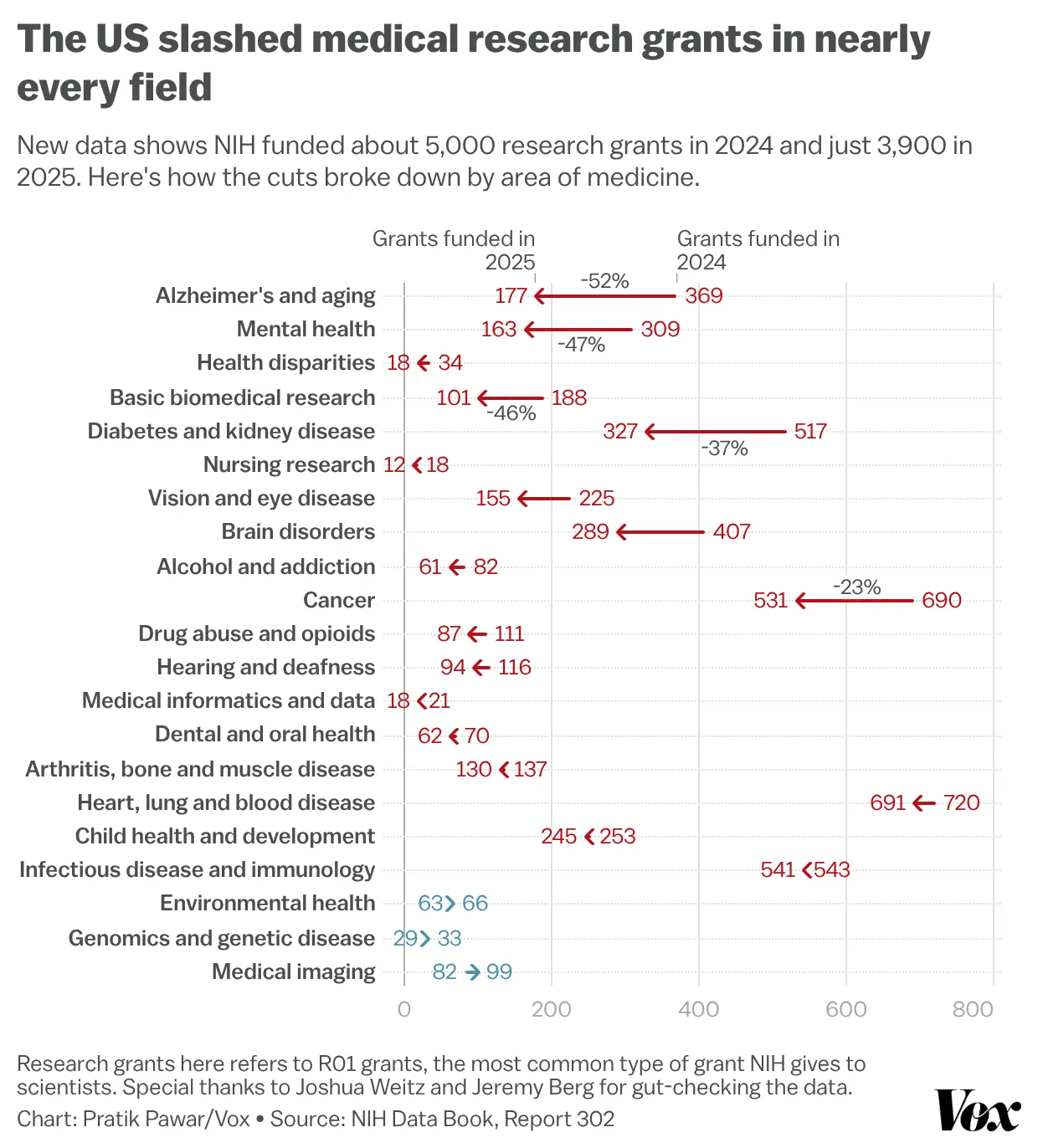
But last year, the United States funded dramatically less medical research that could lead to such breakthroughs. New data released by the NIH this week show how the damage from these kits broke down.
The numbers are impressive across the board.
New grants for Alzheimer’s and aging research are cut in half—from 369 to 177 in 2024, all while the U.S. population is aging rapidly. Mental health research grants fell 47 percent. And new grants for cancer research have fallen 23 percent — even as cancer rates among Gen X and millennial Americans rise sharply. Across all areas, the NIH went from funding nearly 5,000 new research grants in 2024 to just 3,900 in 2025.
“This is the worst year I’ve ever seen, probably going back to 1980.” Jeremy Berg, who led the National Institute of General Medical Sciences from 2003 to 2011, one of NIH’s major institutes.
The NIH funding system was already under pressure—too many researchers chasing too few research dollars. This always means that the smartest and most unconventional ideas struggle to get funding.
But the Trump administration’s policy decisions have dramatically worsened the problem in just one year.
NIH funds research through federal grants. Scientists across the country submit their proposals, a panel of outside experts scores and ranks them, and then each NIH institute—each focusing on a different area of medicine—funds as many high-scoring proposals as its budget allows. About 5,000 new grants are funded in a typical year.
Last year, one policy change did more to reduce that number than anything else.
In July 2025, the White House Office of Management and Budget required the NIH to begin paying the full cost of approved grants in advance — all at once, instead of paying throughout the year, as it is for a longer period of time. In principle, pre-funding makes them less vulnerable to future budget cuts.
But here’s the problem: When the NIH funds a research project, it’s typically a commitment that spans three to five years. This means that every year, about 80 percent of the agency’s budget is already called for – for the grants it promised in previous years. Only the remaining 20 percent of the budget is available to fund new research.
When the agency has to pay the full cost of each multi-year grant up front, that means each new grant costs several times more than the previous one. Michael Lauer, who oversaw NIH grant making for nearly a decade before leaving the agency in early 2025, put it simply: “Instead of funding five grants, you’re now only funding one, and that means the other four grants that were funded won’t be funded.”
Berg, a former director of the NIH Institute, estimates that this single change could eliminate nearly 1,000 new grants.
But this was not the only factor. The Trump administration has also canceled thousands of existing grants in the past year — something Lauer said he has seen happen only twice in his 18-year tenure at the administration. Any money left over from that termination went to the US Treasury, not back to NIH. Berg estimates that about $500 million left the system this way.
Additionally, about 12 percent more grant applications were submitted in 2025 than in 2024, all competing for a shrinking pool of funds.
Trump administration open about wanting smaller NIH; It proposed cutting the agency’s budget by 40 percent for 2026, though Congress has not enacted the cuts. Meanwhile, the White House has pushed for policy changes that it says aim to restore accountability at the NIH — but the effect of those changes is to shrink the agency.
“I think it’s very easy to start wondering if there’s some connection between these two things,” Kerry Wollnitz, a former senior NIH official, told STAT News.
NIH did not respond to specific questions about the institute-wide cuts, or what happened to the expired grant money.
But isn’t the best research still funded?
With so few grants around, you might think that the system is just getting more selective – only funding the best ideas and cutting the rest. But that’s not really how it works.
Philippe Agion, the economist who shared last year’s Nobel Prize, found that beyond a certain point, too much competition actually stifles innovation rather than encourages it. When NIH can only fund 5 or 6 percent of proposals, what survives is good but conservative science—established labs expanding well-established research.
“The main thing you leave behind is new ideas,” Berg said.
Researchers in England recently found that people who were vaccinated against shingles had a nearly 20 percent lower risk of developing dementia seven years later. The finding comes from a natural experiment in Wales, where people born before a certain date were ineligible for the vaccine and those born after – and the group that received the vaccine had lower rates of dementia.
to understand why Whether the shingles vaccine works against dementia, and whether it could lead to new ways to prevent dementia, is the kind of exploratory research that will now struggle to get funding.
Catalin Carrico, who won the 2023 Nobel Prize in Medicine for her work on the mRNA behind Covid vaccines, had her contributions repeatedly rejected before Trump stepped down. The window for unconventional ideas was already narrow. Now it’s even narrower.
And most of the damage can prove to be permanent. When funding dries up, researchers leave—for other countries, for the private sector, for careers outside of science altogether. “Researchers who leave a field or a country to work elsewhere are unlikely to return,” said Joshua Weitz, a University of Maryland professor who tracks science funding.
There are early signs that 2026 could be even worse for medical research. The White House Budget Office has delayed spending 2026 funding to the NIH, even after Congress approved it, and the NIH has made about a third as many new awards as it normally would at this point in the year.
The hardest thing to measure, Berg said, is research that never had a chance to begin. “It’s more like we look across the ocean to see what we can find and cancel the trip. Maybe there’s a beautiful island out there that’s incredibly important, but we’ll never know.”
#cut #research #cancer #Alzheimers #mental #health